Wednesday, December 6, 2017

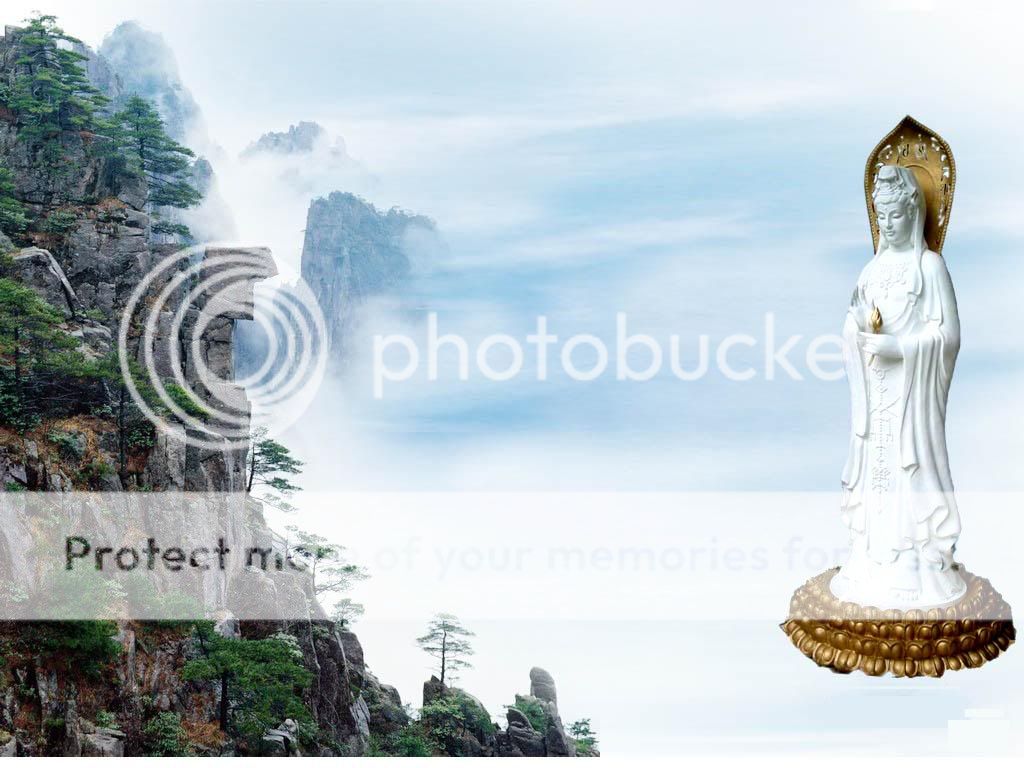
Guan-shi-Yin Bodhisattva


Guan-shi-Yin Pusa

Guan-Shi-Yin (another name of Avalokitesvara ) is the Bodhisattva of compassion and mercy. Guan-shi-Yin means "Observing the Sounds of the World."


Namo Guan-shi-Yin Pusa
Namo great compassionate Avalokitesvara Bodhisattva.

Wednesday, October 18, 2017

Ashoka the Great

Ashoka was the third ruler of the Maurya Dynasty and ruled almost the entire Indian subcontinent from c. 268 to 232 BCE. Let's have a look at his life history, empire, rule, administration and Dhamma.

Wednesday, October 11, 2017

The life of the Buddha with pictures

The history of Buddhism is the story of one man's spiritual journey to Enlightenment, and of the teachings and ways of living that developed from it.

Siddhartha Gautama - The Buddha

By finding the path to Enlightenment, Siddhartha was led from the pain of suffering and rebirth towards the path of Enlightenment and became known as the Buddha or 'awakened one'.

A life of luxury

Opinions differ as to the dates of Siddhartha Gautama's life. Historians have dated his birth and death as circa 566-486 BCE but more recent research suggests that he lived later than this, from around 490 BCE until circa 410 BCE.


He was born into a royal family in the village of Lumbini in present-day Nepal, and his privileged life insulated him from the sufferings of life; sufferings such as sickness, age and death.


Discovering cruel reality

One day, after growing up, marrying and having a child, Siddhartha went outside the royal enclosure where he lived.


When he went outside he saw, each for the first time, an old man, a sick man, and a corpse.This greatly disturbed him, and he learned that sickness, age, and death were the inevitable fate of human beings - a fate no-one could avoid.


Becoming a holy man

Siddhartha had also seen a monk, and he decided this was a sign that he should leave his protected royal life and live as a homeless holy man.


Siddhartha's travels showed him much more of the the suffering of the world. He searched for a way to escape the inevitability of death, old age and pain first by studying with religious men. This didn't provide him with an answer.

A life of self-denial

Siddhartha encountered an Indian ascetic who encouraged him to follow a life of extreme self-denial and discipline.

The Buddha also practised meditation but concluded that in themselves, the highest meditative states were not enough.


Siddhartha followed this life of extreme asceticism for six years, but this did not satisfy him either; he still had not escaped from the world of suffering.


The middle way

He abandoned the strict lifestyle of self-denial and ascetism, but did not return to the pampered luxury of his early life.

Instead, he pursued the Middle Way, which is just what it sounds like; neither luxury nor poverty.


Enlightenment

One day, seated beneath the Bodhi tree (the tree of awakening) Siddhartha became deeply absorbed in meditation, and reflected on his experience of life, determined to penetrate its truth.

He finally achieved Enlightenment and became the Buddha. The Mahabodhi Temple at the site of Buddha's enlightenment, is now a pilgrimage site.


Buddhist legend tells that at first the Buddha was happy to dwell within this state, but Brahma, king of the gods, asked, on behalf of the whole world, that he should share his understanding with others.


The Teacher

Buddha set in motion the wheel of teaching: rather than worshipping one god or gods, Buddhism centres around the timeless importance of the teaching, or the dharma.


For the next 45 years of his life the Buddha taught many disciples, who became Arahants or 'noble ones', who had attained Enlightenment for themselves.
---------------
(https://www.dhammatalks.net/Articles/Life_of_the_Buddha_in_Pictures.htm
http://www.bbc.co.uk)

The cause and effect

The cause and effect (Kamma )


-What is the cause of sufficient transportation ?

-Building bridges and roads for people in previous lives.

-What cause is possessing opulent clothes in this life ?

-Offering the robes to Buddhist monks and nuns in previous lives.

-What is the cause of prosperity in this life ?

-Generously giving alms to the poor in previous lives.

-What is the cause of being poor in the present life ?

-Being selfish and never give anything to help poor people in previous lives.

-What is the cause of having luxurious house in this life ?

-Offering food to the temples in previous lives.


-What is the cause of being happy and wealthy ?

-Building monasteries and supporting accommodation for people in previous lives.


-What is the cause of beautiful appearance in this life ?

-Offering flowers to the Buddha in previous lives.


-Diligently study Buddhist teachings, chant sutras and practice meditation in this life ?

-Getting wisdom and enlightenment in next life.


-What cause are others gratifying to see oneself from ?

-Creating good relationship to people in previous lives.


-What is the cause of having long lived parent ?

-Loving and respecting the lonely elders in previous lives.


-What is the cause of being an orphan ?

-Trapping birds in previous lives.


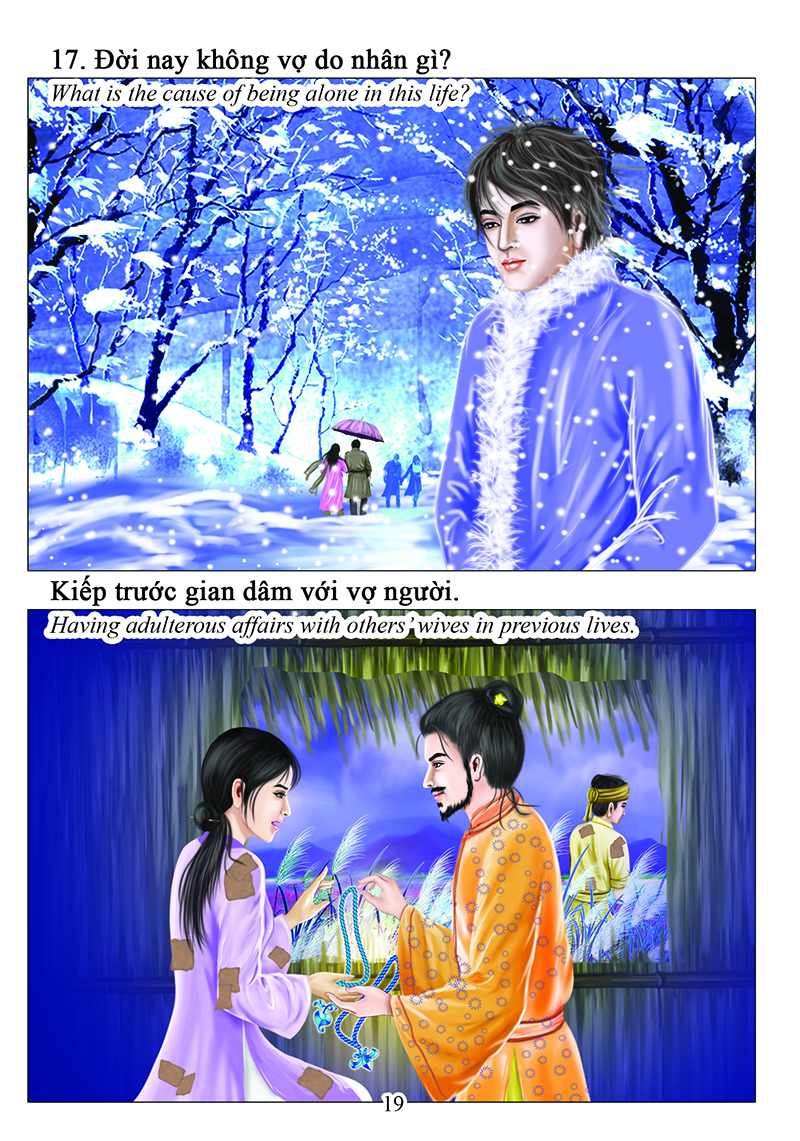
-What is the cause of being alone in this life ?

-Having adulterous affairs with others wives in previous lives.

-What is the cause of widowhood ?

-Disrespecting and looking down upon husband in previous lives.

-What is the cause of having good eye sight in this life ?

-Offering oil and lamp to the Buddha in previous lives.


Whatever we do, we will get the consequence,

Do not blame anyone when receiving retribution.

---

Who cultivates good seeds will get good fruit,

Who does evils will get bad consequence,

Don't say that the cause and effect is untrue,

We will pay karmic debts in near future, or our descendant will in distant future.


To understand your previous lives,

Look at retribution in your present life.

To have a preview of your next life,

Examine your daily acts in this life.

source: truyentranh8.net

Saturday, October 7, 2017

Buddhist pagodas in Vietnam

In Vietnam, Buddhism is the main religion, which greatly influences the culture.
At sunset, after work,  the Buddhist people went to the pagoda to practice under the guidance of the monks.

Buu_Long Pagoda:


Theravada Buddhism,
Chùa Bửu Long, HCM city.
addr : Nguyễn_Xiển Road, Long_Bình Ward,  District : 9, Ho_Chi_Minh City, Vietnam
(20km from Ho Chi Minh City’s centre).


(youtube)
BUU-LONG pagoda

Hoang-Phap pagoda:

 Pure Land Buddhism,
usually organizes Buddhist retreats for a few days, you can attend if you contact.
chuahoangphap.com.vn
Hoang-phap pagoda
Addr: Tan Hiep Commune, Hoc Mon District, Ho-chi-Minh city, Vietnam.


Thuong chieu Buddhist Mediation Institube:

Zen Buddhism,
addr: 1C, Phước Thái, District: Long Thành, Đồng Nai province, Vietnam.

Thiền Viện Thường Chiếu, 
Thuong-chieu

Truc- Lam- Tay- Thien meditation institute:

Zen Buddhism,
THIỀN VIỆN TRÚC LÂM TÂY THIÊN
addr: Commune: Đại Đình – District: Tam Đảo – Vĩnh Phúc province , Vietnam.

Truc- Lam- Tay- Thien
TRUC LAM BUDDHIST MEDIATION INSTITUTE _ Dalat , Vietnam


Van Duc Pagoda

Nam Tong Pagoda

Wednesday, October 4, 2017

Buddhism


Introduction

For more than 2,500 years, the religion we know today as Buddhism has been the primary inspiration behind many successful civilizations, the source of great cultural achievements and a lasting and meaningful guide to the very purpose of life for millions of people. Today, large numbers of men and women from diverse backgrounds throughout our world are following the Teachings of the Buddha. So who was the Buddha and what are His Teachings?


The Buddha

The man who was to become the Buddha was born Siddhattha Gotama around 2,600 years ago as a Prince of a small territory near what is now the Indian-Nepalese border. Though he was raised in splendid comfort, enjoying aristocratic status, no amount of material pleasure could satisify the enquiring and philosophic nature of the young man. At the age of 29 he left palace and family to search for a deeper meaning in the secluded forests and remote mountains of North-East India. He studied under the wisest religious teachers and philosophers of his time, learning all they had to offer, but he found it was not enough. He then struggled alone with the path of self- mortification, taking that practice to the extremes of asceticism, but still to no avail. 

Then, at the age of 35, on the full moon night of May, he sat beneath the branches of what is now known as the Bodhi Tree, in a secluded grove by the banks of the river Neranjara, and developed his mind in deep but luminous, tranquil meditation. Using the extraordinary clarity of such a mind with its sharp penetrative power generated by states of deep inner stillness, he turned his attention to investigate upon the hidden meanings of mind, universe and life. Thus he gained the supreme Enlightenment experience and from that time on he was known as the Buddha. His Enlightenment consisted of the most profound and all-embracing insight into the nature of mind and all phenomena. This Enlightenment was not a revelation from some divine being, but a discovery made by Himself and based on the deepest level of meditation and the clearest experience of the mind. It meant that He was no longer subject to craving, ill-will and delusion but was free from their shackles, having attained the complete ending of all forms of inner suffering and acquired unshakeable peace.


Kamma 

Kamma means 'action'. The Law of Kamma means that there are inescapable results of our actions. There are deeds of body, speech or mind that lead to others' harm, one's own harm, or to the harm of both. Such deeds are called bad (or 'unwholesome') kamma. They are usually motivated by greed, hatred or delusion. Because they bring painful results, they should not be done. 

There are also deeds of body, speech or mind that lead to others' well being, one's own well being, or to the well being of both. Such deeds are called good (or 'wholesome') kamma. They are usually motivated by generosity, compassion or wisdom. Because they bring happy results, they should be done as often as possible. 

Thus much of what one experiences is the result of one's own previous kamma. When misfortune occurs, instead of blaming someone else, one can look for any fault in one's own past conduct. If a fault is found, the experience of its consequences will make one more careful in the future. When happiness occurs, instead of taking it for granted, one can look to see if it is the result of good kamma. If so, the experience of its pleasant results will encourage more good kamma in the future. 

The Buddha pointed out that no being whatsoever, divine or otherwise, has any power to stop the consequences of good and bad kamma. The fact that one reaps just what one sows gives to the Buddhist a greater incentive to avoid all forms of bad kamma while doing as much good kamma as possible. 

Though one cannot escape the results of bad kamma, one can lessen their effect. A spoon of salt mixed in a glass of pure water makes the whole very salty, whereas the same spoon of salt mixed in a freshwater lake hardly changes the taste of the water. Similarly, the result of a bad kamma in a person habitually doing only a small amount of good kamma is painful indeed, whereas the result of the same bad kamma in a person habitually doing a great deal of good kamma is only mildly felt. 

This natural Law of Kamma becomes the force behind, and reason for, the practice of morality and compassion in our society.


( http://www.budsas.org)

Friday, September 29, 2017

Studying Buddhism at Truc Lam meditation institute

Living Vietnam in a day - Studying Buddhism at Truc -Lam -Tay- Thien meditation institute


--------------------------
TRUC LAM BUDDHIST MEDIATION INSTITUTE _ Dalat , Vietnam

Friday, September 1, 2017

Namo Amitabha Buddha -Vietnamese chanting

   (Vietnamese)                                       (English)

Nam-mo  A-Di-Da   Phat   <= >    Namo Amitabha Buddha


Saturday, November 7, 2015

The life of the Buddha

All religions have some basic rules that define what is good conduct and what kind of conduct should be avoided. In Buddhism, the most important rules are the Five Precepts.

1. No killing. 

2. No stealing . 

3. No sexual misconduct. 

4. No lying . 

5. No intoxicants.

"The kind of seed sown
will produce that kind of fruit.
Those who do good will reap good results.
Those who do evil will reap evil results.
If you carefully plant a good seed,
You will joyfully gather good fruit."
(Shakyamuni Buddha)


It was 500 years Before Christ that a young prince set out on a journey. He travelled through pain and suffering to reach Nirvana – the everlasting bliss we all dream of. “Symbol of peace, symbol of compassion, symbol of non-violence,”. He was the Buddha.


---------------
The life of the Buddha with pictures

The Buddhas' Sasana

Namo Tassa Bhagavato Arahato Samma SamBuddhassa

the Buddhas' Sasana

Every evil never doing
and in wholesomeness increasing
and one's heart well-purifying:
this is the Buddhas' Teaching.

Lotus 

Think lightly not of evil,
"It will not come to me",
for by the falling of water drops
a water jar is filled.
The fool with evil fills himself,
he soaks up little by little.

Think lightly not of goodness,
"It will not come to me",
for by the falling of water drops
a water jar is filled.
The sage with goodness fills himself,
he soaks up little by little.

By oneself is evil done,
by oneself defiled,
by oneself it's left undone,
by self alone one purified.
Purity, impurity on oneself depend,
no one can purify another.

(Shakyamuni Buddha)

----------

enmity and amity

Avalokiteśvara  Bodhisattva


Bow the Buddha


Bow to The Buddha

I'm bowing the Buddha

Good Question, Good Answer

Good Question, Good Answer
Bhikkhu Shravasti Dhammika

What is Buddhism?

The name Buddhism comes from the word 'budhi' which means 'to wake up' and thus Buddhism is the philosophy of awakening. This philosophy has its origins in the experience of the man Siddhartha Gotama, known as the Buddha, who was himself awakened at the age of 35. Buddhism is now 2,500 years old and has about 300 million followers worldwide. Until a hundred years ago Buddhism was mainly an Asian philosophy but increasingly it is gaining adherents in Europe, Australia and America.

The Dhamma light

The Dhamma light

Lay Follower


"Venerable Sir, to what extent is one a lay follower?"

The Five Precepts


Five Precepts:

1. No killing. 

2. No stealing . 

3. No sexual misconduct. 

4. No lying . 

5. No intoxicants.

4 Holy Places in Buddhism

Lumbini

Lumbini is in the foothills of the Himalaya, 25 km east of the municipality of Kapilavastu, where the Buddha is said to have lived till the age of 29. Kapilvastu is the name of the place in question as well as of the neighbouring district. Lumbini has a number of temples, including the Mayadevi temple, and others under construction. Also here is the Puskarini or Holy Pond - where the Buddha's mother took the ritual dip prior to his birth and where he, too, had his first bath - as well as the remains of Kapilvastu palace. At other sites near Lumbini, earlier Buddhas were, according to tradition, born, achieved ultimate awakening and finally relinquished earthly form.

Following the Buddha's Footsteps


Following the Buddha's Footsteps
Instilling Goodness School
City of Ten Thousand Buddhas
Talmage, CA 95481 

INTRODUCTION TO BUDDHISM
 
As a child, Siddhartha the Buddha, was troubled by some of the same thoughts that children today have. They wonder about birth and death. They wonder why they get sick and why grandfather died. They wonder why their wishes do not come true. Children also wonder about happiness and the beauty in nature.

EIGHT WORLDLY CONDITIONS

EIGHT WORLDLY CONDITIONS

Vicissitudes of Life (Atthalokadhamma)

FOR THE AGED AND THE SICK

FOR THE AGED AND THE SICK By Ven. Thich Thanh Tu